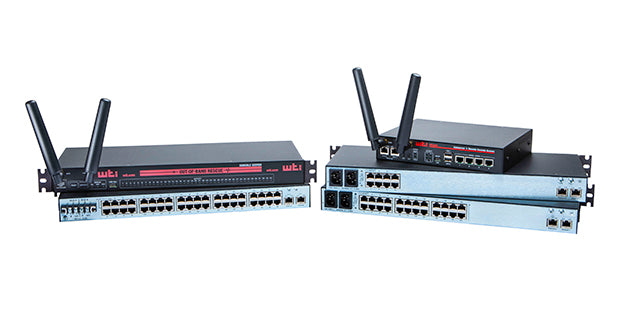
Inside the WTI Linux Powered Console Server, Out of Band Console Port Access ... From Anywhere!
Most network administrators have days like this at least once a month. First, network communication goes down or slows to a crawl. Soon after that, an avalanche of calls and email hits; urgent message after urgent message, all demanding to know when the network will be up and running again. In most cases, the task of finding and correcting the problem is easy; the only challenging part of the job is gaining access to console port command functions on the network element that caused the crash … a task that’s doubly difficult if the troubled network element is located off-site, at a data center or network equipment rack far away from your central office.
But it doesn’t really need to be that difficult. If you’ve got a WTI Linux Powered Console Server inside your equipment rack, then it’s easy as pie to create an out of band connection to a console port on the troublesome network element and get down to the business of fixing the problem; without traveling to the remote equipment site, without an expensive service call and with far fewer angry emails and calls from frustrated network users.
WTI offers three Linux Powered Console Server product lines; RJ45 Port Linux Powered Console Servers (TSM Series), DB9 Port Linux Powered Console Servers (RSM Series) and RJ45 Port Linux Powered Console Server + Power Control Hybrids:
Inside a WTI Linux Powered Console Server...Secure Access to Command Functions on Remote Network Devices
- Access Serial Console Ports via Network, Modem or Local Setup Port
- Secure Access to Console Port Command Functions on Remote Devices
- Embedded Validated FIPS 140-2 Cryptographic Module
- Remote Authentication: LDAP, Kerberos, RADIUS, TACACS+
- Monitor Environment and Conditions in Remote Network Cabinets
- Event Notification via SNMP, Email, Text Message, SYSLOG
- Multi-Level Subscriber Directory Controls Port Access and Command Access
- Multiple Concurrent SSH Sessions
- Full MIB Support
- Supports Both IPv4 and IPv6
SNMP Control and Full MIB support
WTI Linux Powered Console Servers include SNMP compatibility and full MIB support, providing network administrators with the ability to employ managed MIB objects to select configuration parameters, monitor the status of the Linux Powered Console Server and manage user accounts for the Linux Powered Console Server. When alarms functions are enabled at Linux Powered Console Server, SNMP Traps can be generated to automatically notify support personnel whenever user-defined critical conditions are detected.
Multi-level User Directory - An Ideal fit for Co-location Applications
A multi-level user directory and security and authentication protocols work together to provide a perfect solution for co-location applications. The Linux Power Console Server’s user directory drastically simplifies the process of granting multiple users with different levels of command access and port access privileges. The Linux Power Console Server streamlines the task of setting up user accounts and selecting distinct serial port and command privileges for each account. The WTI Linux Powered Console Server also supports LDAP, Kerberos, TACACS+ and RADIUS authentication protocols, in addition to SSHv2 encryption and IP address filtering, providing further assurance that unauthorized users will not be allowed to access sensitive command functions.
Outbound SSH and Telnet Connections
WTI Linux Powered Console Servers offer the ability to establish secure, encrypted outbound SSH and Telnet connections to network devices via dial-up; a very valuable capability when your normal network is down or network access is impractical. When communication via the primary network is unavailable, network administrators can still contact the Linux Powered Console Server via secondary network or dial-up and then create outbound SSH or outbound Telnet connections, allowing secure communication with other network elements located on the local area network or intranet. The outbound SSH/Telnet features also come in handy when communicating with network devices located at remote facilities outside the reach of a normal network connections, such as network equipment racks on oil rigs or remote equipment closets located at power transmission stations. In cases like these, administrators can establish a secure connection to the Linux Powered Console Server via dial-up modem or satellite modem, and then create outbound SSH or Telnet sessions in order to communicate with other devices at the remote installation.
HTTPS Web Access
Support for HTTPS provides network administrators with a secure, convenient means to access command and configuration functions on the WTI Linux Powered Console Server. HTTPS Web Access allows network administrators to create self-signed security certificates without the need to rely on an outside service, effectively eliminating the bothersome chore of setting up domain name servers to recognize the WTI Linux Powered Console Server. The Linux Powered Console Server also supports SSL security certificates and server private keys, providing advanced encryption capabilities and additional authentication for higher level security during web based communication.
Supports Both IPv4 and IPv6
In order to prepare for the upcoming switchover to IPv6 protocol, all WTI Linux Powered Console Servers now provide full support for both IPv4 and IPv6 (the intended successor to IPv4.) This helps to ensure that WTI Linux Powered Console Servers purchased today will be fully compatible with the planned IPv6 internet environment, and will not be rendered obsolete when the IPv6 protocol eventually becomes the new worldwide standard for network communications.